
— Our Services —
Our Digital and Data Advisory Services for enterprise project needs.
Digital &
Data Advisory
Digital Microcredentials
Digital
Ecosystems

Disruptive Technologies
Utopia Digital's data and digital services
bring together strategy, technology,
and deep industry expertise to help
organisations design, connect, and get
the most out of their digital infrastructure.
— Our Advisory —
Digital & Data Advisory
We help the Architecture, Engineering, and Construction (AEC) industry optimise projects through smart digital strategies. From planning to handover, we streamline processes using ISO-aligned workflows that connect people, data, and systems for better outcomes.

-
Our service advises AEC firms on adapting digital delivery methodologies and new ways of working. We tailor strategies to suit your existing technology and operating model, industry compliant delivery through ISO 19650 delivery. We provide guidance on adhering to information standards ISO 27001/2.
-
Enterprise Architecture integrates AEC delivery and IT strategies, using frameworks like TOGAF for alignment with strategic goals. We unite project delivery and IT infrastructure teams, which is crucial for the cultural digital transformation required to deliver a project. This approach ensures people’s agility and digital readiness.
-
We aim to bring clarity to our client’s data environments through the implementation of DAMA-DMBOK framework - establishing governance, quality, and security. Through data restructuring we improve the accessibility of your digital datasets, to improve your decision making and operations.
-
We provide a comprehensive service that guides AEC projects through the adoption and integration of digital tools and methodologies for project delivery. We offer expertise in implementing DE tools; CAD, BIM, GIS, and Survey, into an integrated CDE ecosystem, ensuring your workforce is trained and your data models are optimised for digital delivery.
-
We develop the necessary technological foundation for the creation of digital twins from information developed during the lifecycle of AEC projects. We set up digital systems, train your team on their use, and providing ongoing support to ensure effective management of digital twins for real-time analysis and decision-making.
-
Our Digital Delivery & Handover service ensures a smooth data handover process at the project's completion. We offer targeted support and digital solutions to transition information from the project CDE to the Enterprise Asset Management System (EAMS) ensuring that all project data verfied and compliance with ISO 55001.
Talk to us about the following:
ISO 19650: A global standard that establishes guiding principles on managing information over the whole life cycle of a built asset using building information modelling (BIM)."
Digital Engineering: A modern discipline involving the integrated, digital approach to engineering that uses detailed models and simulations for project planning, delivery, and management.
DAMA-DMBOK: A compendium of guidelines and best practices for data management developed by the Data Management Association to guide data governance and management efforts.
ISO 27001/2: International standards specifying the requirements for establishing, implementing, maintaining, and continually improving an information security management system.
TOGAF: A framework and methodology that provides a comprehensive approach to the design, planning, implementation, and governance of an enterprise information architecture.
ISO 55001: An international standard that specifies requirements for an effective asset management system, focusing on developing, coordinating, and the control to achieve asset-related objectives.
— Our Training —
Digital Microcredentials
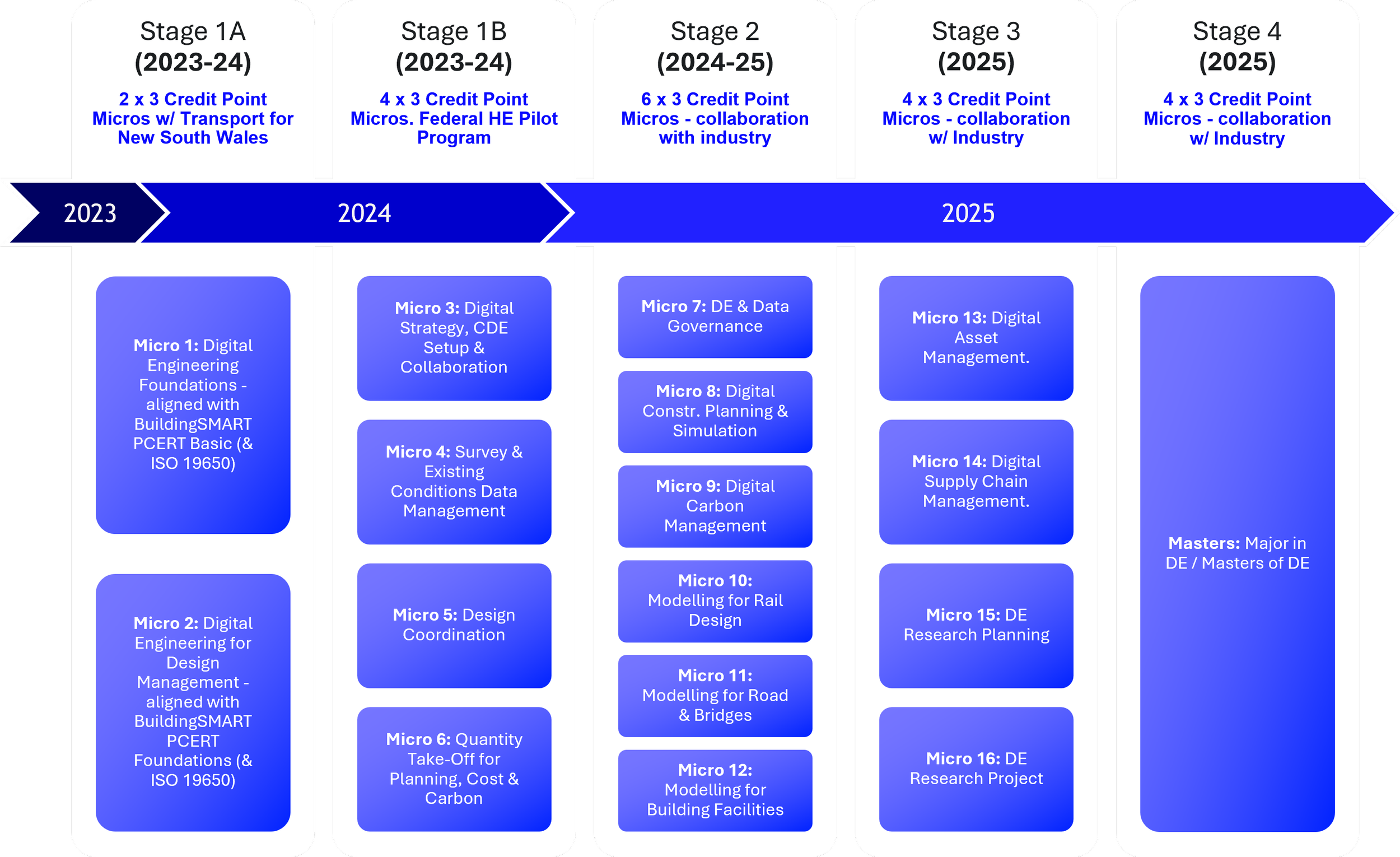
In partnership with UTS and TfNSW, we offer industry-first Microcredentials in digital engineering, CDE workflows, and data management, giving your organisation the practical skills to undertake a digital transformation.
University of Technology Sydney (UTS) and Transport for NSW’s (TfNSW)Digital Engineering Microcredentials - Delivered by Utopia Digital:
Built for industry relevance.
Each credential is co-designed with input from leading infrastructure agencies and aligns with real project demands. We focus on practical application to equip professionals to navigate digital delivery environments with confidence.
+
Certification and beyond.
Our Microcredentials aren’t just learning moments - they’re stepping stones. Stack them toward broader University qualifications or integrate them into internal training frameworks to uplift digital maturity and capability at scale.
"Our microcredentials go beyond theory—delivering hands-on skills with the tools and workflows used at every stage of the project lifecycle."
The foundation of our approach.
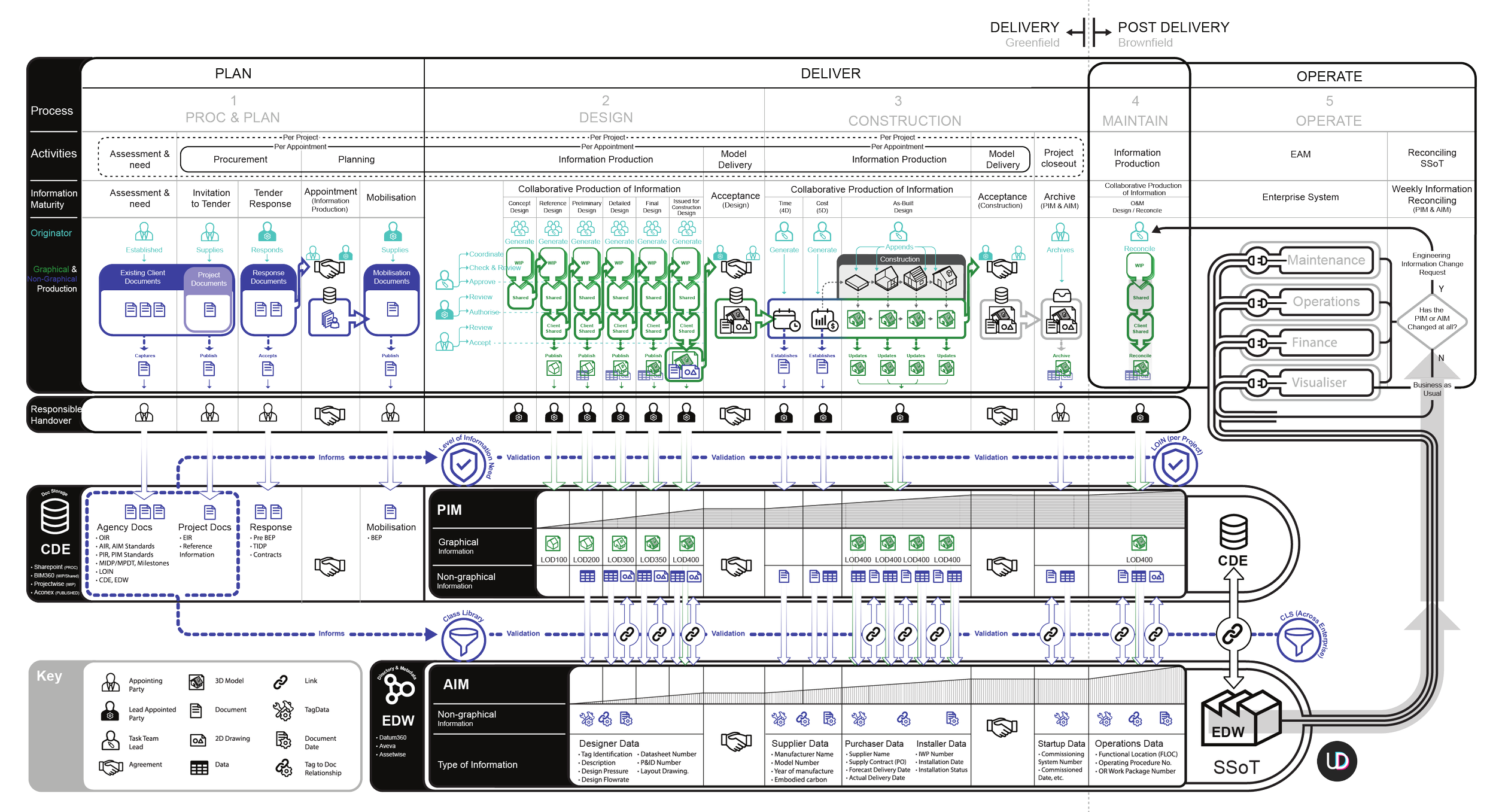
Each Utopia Digital microcredential is mapped to real project stages—covering procurement, planning, design, construction, handover, and operations. We ensure learners understand not just when, but why and how information is managed throughout the lifecycle.
Applied knowledge, not just concepts.
Our programs build capability in CDE workflows, model validation, data maturity (LOD), structured handovers, and AIM practices. Aligned with ISO 19650, these skills prepare professionals to make confident decisions from project setup through to asset maintenance.
— Our Ecosystems —
Digital Ecosystems
We design integrated, vendor-neutral ecosystems across cloud, on-prem, and hybrid setups. By connecting CDEs, enterprise tools, and security frameworks, delivering a single source of truth for your projects.

-
Enterprise frameworks integrate your digital and business strategies, facilitated by technology and AEC processes. Our service aims to have your digital initiatives aligned with your organisational objectives, promoting effective digital transformation and enhancing operational efficiency.
-
Our CDE Implementation service provides a structured approach to establishing a Common Data Environment, critical for efficient data management and collaborative work in AEC projects. We tailor the CDE to fit your specific project needs and workflows, ensuring it becomes an easy core part of your delivery.
-
We offer CDE integration services that connect disparate software and systems, creating a unified and interoperable digital ecosystem. This integration facilitates a streamlined workflow, improving data sharing and collaboration across teams and disciplines, thereby enhancing project decision-making.
-
Our service in CDE automations focuses on optimising your Common Data Environment by automating repetitive tasks and data workflows. This not only increases efficiency but also reduces the potential for human error, enabling your team to focus on more strategic and creative tasks, accelerating project delivery.
-
We design and implement robust data pipelines to ensure efficient data flow and processing within your digital ecosystem. This service is vital for managing large volumes of data, enabling effective data analysis, enhancing data quality, and supporting informed decision-making across your organisation.
-
Focusing on CDE security, we provide services aimed at safeguarding your data within the Common Data Environment. We implement security protocols and measures to protect data integrity and confidentiality within the CDE, ensuring your digital assets are secure and compliant with relevant industry standards
Talk to ask us about the following:
Common Data Environment (CDE): A centralised digital space that stores, manages, and disseminates information for all project teams, ensuring data consistency and collaboration.
API Integration: The process of connecting different systems and applications via their APIs (Application Programming Interfaces) to allow them to exchange data and functionalities.
Data Lake: A storage repository that holds a vast amount of raw data in its native format until it is needed, supporting the storing, processing, and analysing data in various formats.
Data Pipeline: A set of data processing elements connected in series, where the output of one element is the input of the next, used for aggregating and manipulating data.
RESTful API: An architectural style for an application program interface (API) that uses HTTP requests to access and use data, offering a stateless, client-server, cacheable coms protocol.
ETL (Extract, Transform, Load): A data integration process involving data extraction from different sources, transforming it into a format suitable for analysis, and loading to target database.
— Future Technologies —
Disruptive Technologies
We guide organisations in adopting AI, Digital Twins, and emerging technologies. Through research partnerships and real-world delivery, we turn innovation into practical tools for future-focused infrastructure.
Digital Twins in an AI-era.
We help organisations move beyond static BIM and rigid schema-based systems into intelligent, AI-native digital ecosystems. By leveraging Model Context Protocols (MCPs), LLMs, and Retrieval-Augmented Generation (RAG), we enable real-time validation, automation, and data interoperability across the project lifecycle. These next-gen twins respond dynamically to context, support autonomous decision-making, and reduce manual overhead—transforming data into an active participant in the design, delivery, and operations of infrastructure.
AI-Ready Projects.
We prepare clients to navigate the convergence of AI and infrastruture projects through scalable, protocol-driven data architecture. Using MCPs as a common language between systems, we enable vendor-agnostic integration, predictive modelling, and lifecycle assurance. Our frameworks support advanced analytics, and future simulation capabilities in partnership with University of Technology Sydney - laying the groundwork for infrastructure that’s smarter, faster, and more resilient.